
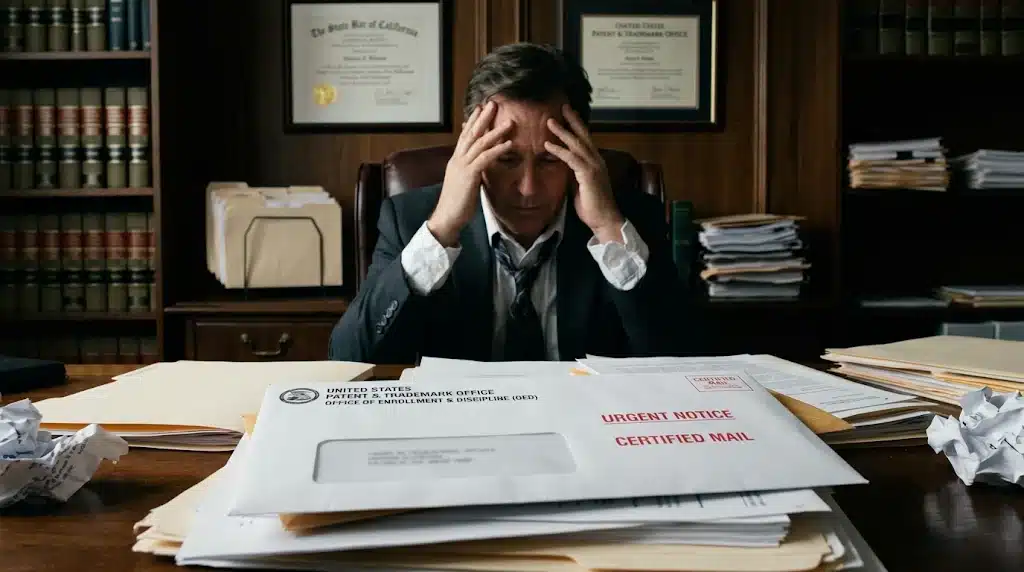
When a practitioner receives a Request for Information from the USPTO’s Office of Enrollment and Discipline (OED), the natural reaction might be panic, dread, or a desire to hide under the covers. But a recent Initial Decision on Default Judgment—Proceeding No. D2026-04 (issued October 6, 2026)—highlights a cardinal rule of ethics: the absolute worst response to the OED is no response at all.
By ignoring the USPTO, the respondent in this matter, Kyriacos Stavrou Tsircou, turned what should have been a routine reciprocal discipline case into a potentially career-ending nightmare.
The Ripple Effect of Ignoring OED
The facts underlying this default judgment paint a familiar picture. The respondent, who was recently disciplined by the State Bar of California with respect to his conduct in another provisional patent matter, failed to respond to OED’s requests for information. When the staff attorney tried to contact him by other means, he provided generic non-responsive e-mails.
Instead of cooperating, this practitioner simply ignored the OED. After multiple attempts to get Mr. Tsircou’s side of the story, OED ultimately filed a complaint.
Default Judgment: A Fatal Unforced Error
Once the formal proceeding was initiated, Mr. Tsircou went completely dark and failed to respond to the proceedings, forcing the Administrative Law Judge (ALJ) to issue an Initial Decision on Default Judgment.
In USPTO disciplinary proceedings, a default judgment is a fatal error. Under the rules, failing to file an answer is treated as an admission of the allegations. But more importantly, failing to cooperate with the OED is an independent ethical violation under 37 C.F.R. § 11.801(b). By ignoring the proceedings, the practitioner all but guaranteed the harshest possible penalty from the USPTO—which, in default cases, often results in exclusion (disbarment) from practice before the Office.
From Bad to Worse in California
The tragedy here is that the bleeding will not stop at the USPTO. Because the USPTO has now issued a final default order, that disciplinary action creates a brand new basis for reciprocal discipline back in California. It is highly likely that the California bar, which had already disciplined him for other conduct, will now initiate new reciprocal proceedings based entirely on the USPTO’s default judgment.
The end result? The practitioner is now facing likely disbarment in California.
This devastating outcome could have been entirely avoided. Had the practitioner simply engaged with the OED—even briefly, by filing a response (even if not accepting the USPTO’s allegations)—the discipline would likely have been much less severe–or even no discipline. By choosing to bury his head in the sand, he inadvertently weaponized his own conduct.
The Takeaway
The OED does not go away just because you stop opening their mail, or fail to respond to their e-mails. If you find yourself in the crosshairs of a USPTO ethics investigation, ignoring the problem will only accelerate your demise. Whether you are facing an original investigation or a reciprocal disciplinary action, engaging with the process is not optional. A brief, cooperative response can often mean the difference between a temporary suspension and permanent disbarment.